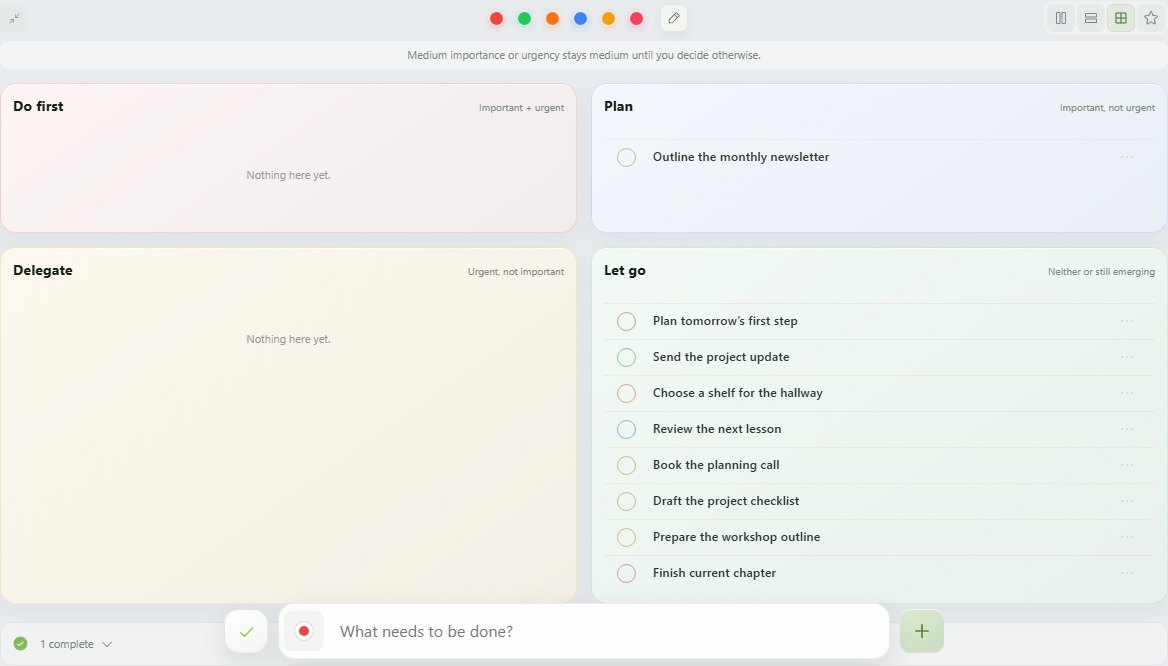
A priority system should reduce decisions, not create a second project. MossyMind keeps importance and urgency optional. When you need them, each task can move into a clear outcome: Do first, Plan, Delegate, or Let go. Medium signals remain medium until you make a deliberate choice.
Importance and urgency answer different questions
Important work meaningfully affects a goal, responsibility, or consequence. Urgent work has a real time pressure. A task can be one, both, or neither. Separating the questions helps expose work that feels loud without actually mattering.
Use four outcomes, not forty ranks
Do first is important and urgent. Plan is important but not yet urgent. Delegate is urgent but does not require your direct work. Let go contains low-value work and tasks still waiting for a clearer decision. The labels are prompts, not moral judgments.
Know when the matrix is the wrong tool
Do not classify every tiny task. Do not pretend an uncertain task is unimportant just to empty a quadrant. If choosing signals takes longer than doing a small task, the matrix is not helping. Return to a category list and choose one next move.
Move the decision with the task
Drag a task between quadrants or change its importance and urgency controls. The task remains the same object: its title, note, date, category, completion state, and focus link travel with it.
Turn four tasks into four outcomes
- Open the four-square priority view.
- For each competing task, decide whether the consequence is important.
- Decide whether the time pressure is real and current.
- Move the task to Do first, Plan, Delegate, or Let go.
- Leave medium or uncertain signals undecided until you have better information.
Research behind this guide
This research explains the ADHD-related challenges discussed here. It does not prove that MossyMind changes ADHD symptoms.
- CDC — ADHD in Adults
Current overview of adult ADHD and common difficulties with attention, lengthy tasks, and organization.
- NICE guideline NG87 — ADHD diagnosis and management
Clinical guidance that includes individualized environmental modifications and non-pharmacological support.