To build a habit, choose one small action, tie it to a cue you meet every day, and repeat it in that same context until it starts with less thought. For most people that takes weeks to months, not 21 days, and a missed day does not erase the progress. The guides in this section take each part in turn: realistic timelines, reliable cues, small starting versions, your surroundings, restarting after a lapse, and adapting all of it for ADHD.
Start with the one that sounds like today.
What a habit is, and why willpower is the wrong tool
A habit is an action your surroundings start for you. Researchers define habits as behaviors triggered automatically by cues that have been paired with them, like reaching for the seatbelt after getting into the car. Once the cue does the starting, the behavior depends far less on attention and motivation, which is why habits can keep going after enthusiasm fades.
That definition changes the job. You are not trying to feel motivated every day. You are trying to teach a moment, a place, or a previous action to start the behavior. Repetition in a consistent context does the teaching, and it takes longer than most people expect. The real numbers are in how long it takes to form a habit.
Where new habits usually break
Most failed habits fail at one of four points. Each needs a different fix, so name yours before you try again.
- The cue is vague. “Sometime in the morning” is not a moment you meet the same way each day. Habit stacking ties the new habit to something you already do.
- The action is too big for a bad day, so it only happens on good ones. Starting small protects the cue when energy drops.
- The surroundings fight the habit: the guitar is in its case and the phone is on the pillow. Environment design moves the friction to where it helps.
- One missed day turns into “I ruined it.” What to do after breaking a streak has a next-day restart script.
If your days rarely run the same way twice
Habit research mostly follows volunteers with fairly steady routines, and very few studies test habit methods in adults with ADHD. That does not put habits out of reach. It means the plan needs more visible cues, smaller minimums, and a forgiving way to count. Building habits with ADHD adapts the general evidence and says plainly where it is guesswork. The ADHD morning routine applies the same ideas to the hour that derails many days.
How MossyMind holds a habit
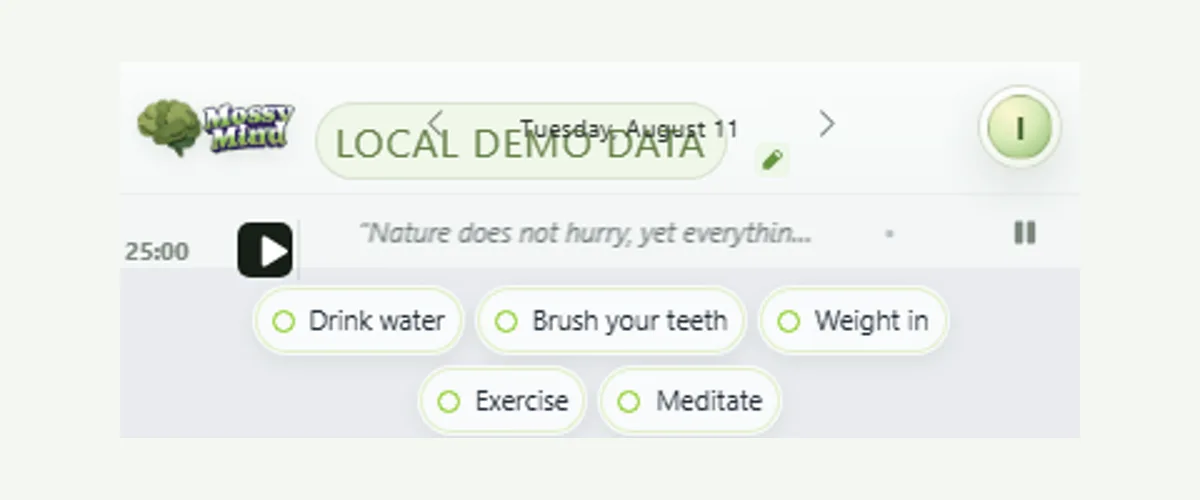
In MossyMind, habits sit in a small bar at the top of Today, on the same surface as your tasks, so checking one off does not mean opening another app. Tap a habit to complete it and tap again to undo. Completed habits move to a quieter row, which keeps the remaining ones easy to see. A long press, or a right-click on desktop, opens a seven-day history, the current streak, and options to rename or remove the habit.
There are no reminders, badges, or streak rewards. The cue lives in your day, and the record stays quiet until you ask for it. The calendar marks days with completed habits when you want a longer view. The habit tracker page shows the details.
 See how it works
Research behind this page
This research explains the challenges discussed here. It does not prove that MossyMind changes ADHD symptoms or any health outcome.
- Lally et al. (2010) — How are habits formed: Modelling habit formation in the real world
96 volunteers repeated a chosen daily behavior for 12 weeks; time to reach most of its automaticity ranged from 18 to 254 days.
- Gardner, Lally & Wardle (2012) — Making health habitual: the psychology of “habit-formation” and general practice
British Journal of General Practice article on habit-formation advice: repeat a simple action in a consistent context; reports automaticity plateauing around 66 days and gains resuming soon after one missed performance.
- Singh et al. (2024) — Time to form a habit: a systematic review and meta-analysis of health behaviour habit formation
Review of 20 studies (2,601 participants): median habit formation times of 59 to 66 days, individual times from 4 to 335 days; morning practice and self-chosen habits linked to stronger habits.