
Good daily planning and prioritization come down to three honest moves. Fit the plan to the hours you really have. Choose by consequence rather than by whichever task is loudest. Leave the day with a note that makes tomorrow easy to re-enter. Most plans fail at one of those points, and not because the person planning is lazy. These guides take each failure point in turn and give you something to do about it in the next ten minutes.
Start with the one that sounds like today.
Where plans usually break
Plans usually break in four places. The estimate was too hopeful, so the day overflowed by lunch. The loudest task won, even though a quieter one mattered more. The list grew until it became a wall of old obligations. Or the day ended mid-task, and the unfinished work followed you into the evening.
None of these is a character flaw. People routinely underestimate how long their own tasks will take, even after running late on similar work. Time pressure also pulls attention by itself: in a set of experiments, people chose lower-value tasks simply because those tasks looked like they were about to expire. For adults with ADHD, differences in time perception and working memory can make both problems louder.
Plan for capacity before ambition
A useful plan starts with arithmetic, not aspiration. Count the hours you actually have after meetings, travel, meals, and transitions. Pad your estimates. Then decide what fits. How many tasks should be on a to-do list walks through that math, and time blocking with ADHD shows how to give important work a protected start time without pretending the day will run to the minute.
Capacity also has a weekly shape. A short weekly review catches what slipped, looks at the fixed commitments ahead, and chooses a few outcomes before Monday chooses them for you.
Choose by consequence, not by volume
Prioritizing is not ranking every task from one to forty. It is asking, for the few tasks competing right now, what happens if each one waits and whether its deadline is real. The guide to prioritizing tasks with ADHD gives four questions to ask in order. To see the importance-and-urgency grid applied to ordinary work, home, and school tasks, the Eisenhower matrix examples sort sixteen of them and name the usual mistakes.
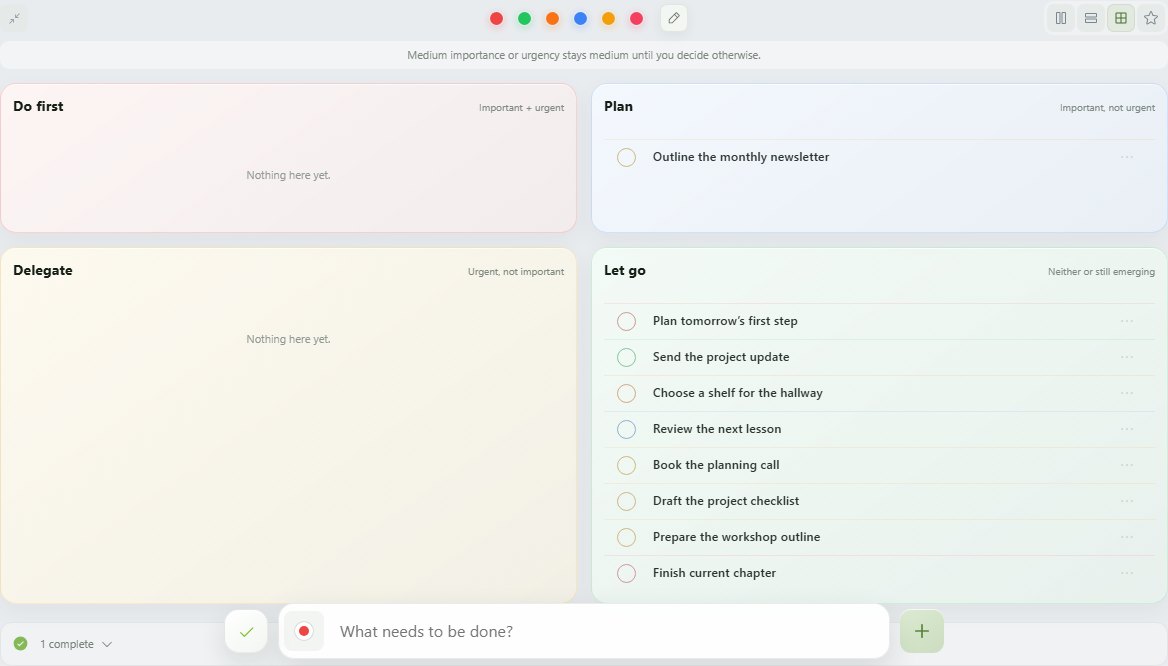
In MossyMind, importance and urgency are optional signals on each task, and the priority view turns them into four outcomes: Do first, Plan, Delegate, and Let go.
Make the plan easy to re-enter
A day you can return to beats a perfect day you abandon at 10:40. Keep Today short enough to read at a glance. When the list has grown into a backlog you avoid opening, an overwhelming to-do list reset archives it safely and keeps only what is still alive. At the end of the workday, an end-of-day shutdown routine closes open loops with return notes rather than finished projects. The ADHD daily planning loop ties these moves together so you can enter at any point.
MossyMind’s task list carries unfinished work forward to Today automatically, so a missed day does not become a red pile of overdue items. Future tasks wait on the day you gave them. MossyMind does not send reminders, create recurring tasks, or sync with an outside calendar, so the planning rhythm has to come from cues already in your week.
What planning cannot fix
No planning method makes an impossible workload possible. If every week overflows, the honest moves are to renegotiate deadlines, hand work to someone else, or drop commitments on purpose. If planning trouble is persistent and distressing, or arrives with low mood, exhaustion, or poor sleep, talk to a clinician. A planner can make the day easier to see. It is not ADHD treatment.
 See how it works
Research behind this page
This research explains the challenges discussed here. It does not prove that MossyMind changes ADHD symptoms or any health outcome.
- Buehler, Griffin & Ross (1994) — Exploring the “planning fallacy”: Why people underestimate their task completion times
Five studies of university students: predictions were too optimistic (thesis students took about 55 days against a 34-day average estimate), and the bias disappeared when people linked relevant past experiences to their prediction.
- Zhu, Yang & Hsee (2018) — The mere urgency effect
Five experiments in which people chose lower-payoff tasks that merely looked about to expire; highlighting payoffs at the moment of choice weakened the effect, and self-described busy people showed more of it.
- CDC — ADHD in Adults
Current overview of adult ADHD and common difficulties with attention, lengthy tasks, and organization.
- Metcalfe et al. — ADHD time-perception meta-analysis
Systematic review and meta-analysis of time-perception differences across the lifespan.