When you are unmotivated, start by making the first move smaller instead of waiting for the feeling. Motivation often arrives after you begin, once the task turns out clearer and lighter than it looked from the outside. The guides here cover the different reasons starting stalls, from dread and boredom to low energy, with practical moves and honest notes on what the evidence does and does not show.
Start with the one that sounds like today.
Where does starting usually break?
Low motivation is a description, not a diagnosis. The useful question is what makes this particular start expensive today, because different answers need different moves. Most stalled starts fall into one of a few patterns, and each has its own guide.
- The task feels bad to face, so putting it off brings relief: read ADHD procrastination.
- You know what to do but freeze at the starting line: read ADHD task paralysis.
- The task is dull and its payoff is far away: read how to do boring tasks with ADHD.
- You are waiting to feel ready: read how to get motivated when you don’t feel like it.
- Your energy is genuinely low today: read what to do on a low energy day.
How these guides approach motivation
The guides share one idea: lower the cost of starting instead of raising the pressure. Procrastination research describes delay largely as short-term mood repair, a way to get relief from a task that feels bad right now. A large meta-analysis found that unpleasant tasks, impulsiveness, and low confidence were strong, consistent predictors of procrastination, while traits such as rebelliousness and sensation seeking showed only weak links.
So the moves are practical. Shrink the first step, bring the payoff closer, put a short boundary around the start, and forgive the last delay so it does not make the next start harder. Popular rules such as the two-minute rule are labeled as heuristics. Where studies exist, the guides say who was studied, and where the evidence is thin or comes from a different population, they say that too.
How MossyMind supports starting
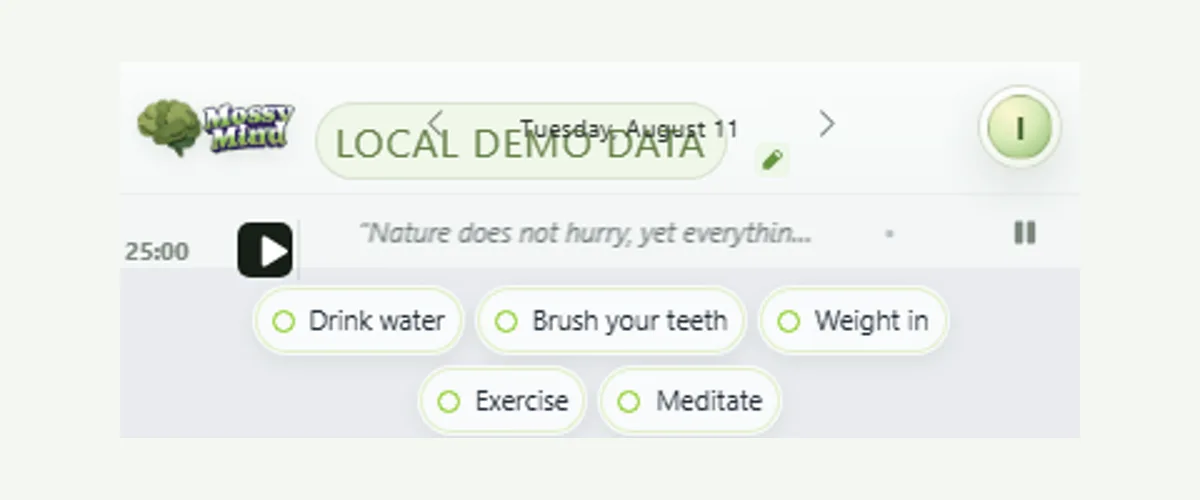
MossyMind is built to keep the first move visible and small. In Tasks, you can write the first move itself as the task and put the bigger job in a group named for it. Unfinished tasks carry forward to Today, so a delayed task comes back as something to shrink rather than a red overdue pile.
When you are ready, choose Focus on this task, and the focus timer shows that task’s name while it runs, using work and rest lengths you set in account settings. A short session gives the start an edge you are allowed to leave. The habit bar can hold a temptation bundle you want to repeat. MossyMind does not treat ADHD or low mood. It makes starting a little cheaper.
When motivation is not the problem
If you feel flat about almost everything rather than about certain tasks, or tiredness has lasted for weeks without a clear reason, treat that as a reason to see a doctor or mental health professional, not as a motivation problem to solve with better technique. If you are thinking about harming yourself, contact local emergency services or a crisis line (in the US, call or text 988).
 See how it works
Research behind this page
This research explains the challenges discussed here. It does not prove that MossyMind changes ADHD symptoms or any health outcome.
- Sirois & Pychyl (2013) — Procrastination and the priority of short-term mood regulation
Review arguing that procrastination is largely short-term mood repair, with its costs shifted onto the future self.
- Steel (2007) — The nature of procrastination: a meta-analytic and theoretical review
Meta-analysis of 691 correlations; task aversiveness, task delay, self-efficacy, and impulsiveness were among the strongest and most consistent predictors.