To focus better, change the conditions around the work before asking more of yourself: name one task, put a visible boundary around it, keep a place for stray thoughts, and decide how you will come back after an interruption. That approach suits ADHD and ordinary overloaded days alike. The guides below take one breaking point at a time, from phones and background noise to hyperfocus and hard transitions, and say plainly where the research is solid, thin, or about a different population.
Start with the one that sounds like today.
Where does focus usually break?
Focus rarely fails in one dramatic moment. It leaks at specific points, and each leak needs a different repair. Before you change apps, timers, or playlists, notice which of these sounds most like your week. The answer tells you which guide to open first.
- Before the start: the task is vague, so attention slides toward something easier.
- Mid-session: a notification, a colleague, or your own thought pulls you sideways.
- At the edges: moving between meetings, tasks, or places costs more than the work itself.
- After a break: you know you were interrupted but cannot find where you were.
- Too much focus: you lock onto one thing and lose the afternoon or a commitment.
How these guides approach focus
Each guide starts with the question people actually search for and answers it with methods you can test today. How to stop getting distracted while working begins by sorting each distraction into external, internal, or escape, because each needs a different response. ADHD task switching treats transitions as work that deserves its own minutes. Other guides cover the phone on your desk, deep work sessions sized for a real week, and the opposite problem of hyperfocus that will not let go.
Evidence is labeled honestly. Switch costs and interruption costs are well documented in general populations. Research on background noise and ADHD is small and mostly about children and young adults, which is why the brown noise guide frames listening as a self-experiment rather than a fix. When a popular claim has replicated poorly, the guide says so.
What a timer can and cannot do
A timer does not create focus. It makes time visible and gives a work period an edge, which can make starting cheaper and stopping deliberate. Interval length is a personal setting, not a rule: Pomodoro for ADHD shows how to test short, medium, and longer sessions against the same task. Clinical guidance for ADHD lists shorter periods of focus with movement breaks among possible environmental adjustments, chosen for the person rather than prescribed for everyone.
How MossyMind supports focus
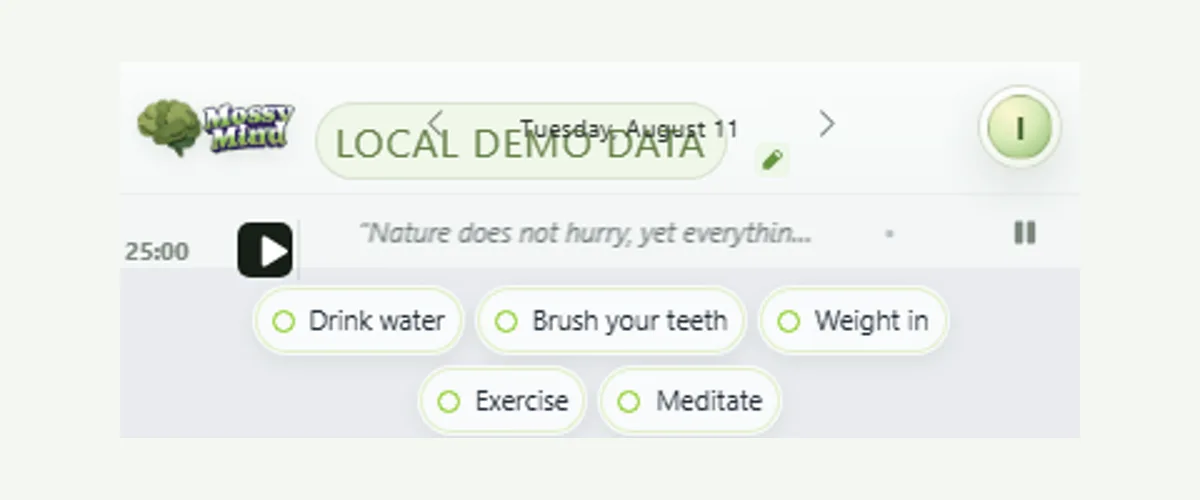
The focus timer attaches to a real task from its menu, shows the task name while it runs, and uses work and rest lengths you set in account settings. The capture dock stays on the daily desk, so a stray thought can become a task without opening another app. Unfinished tasks carry forward to Today, so renaming a task to its next move leaves you the line you will need when you come back.
MossyMind does not send reminders, play background sound, or block apps. It is a calm place to name the work, bound it, and return to it. For most people that combination, a defined session plus an easy way back in, matters more than any single setting.
 See how it works
Research behind this page
This research explains the challenges discussed here. It does not prove that MossyMind changes ADHD symptoms or any health outcome.
- CDC — ADHD in Adults
Current overview of adult ADHD and common difficulties with attention, lengthy tasks, and organization.
- NICE guideline NG87 — ADHD diagnosis and management
Clinical guidance that includes individualized environmental modifications and non-pharmacological support.
- Monsell (2003) — Task switching
Review: responses are slower and usually more error-prone right after a task switch; preparation reduces this switch cost but does not eliminate it.
- Mark, Gudith & Klocke (2008) — The cost of interrupted work: more speed and stress
Lab study of 48 people answering email: when interrupted, they finished faster with no loss of quality but reported more stress, frustration, time pressure, and effort.