
Stoicism in everyday life comes down to a few small, repeatable moves: notice what is actually up to you, meet the morning with a short preview, return to the task in front of you, and look back at the evening without turning it into a trial. Seneca, Epictetus, and Marcus Aurelius wrote these practices as letters, lectures, and private notes. The guides here keep their words, checked against public-domain translations, and turn them into routines that take minutes.
Start with the one that sounds like today.
What Stoicism is for, and what it is not
Stoicism is a philosophy of attention and judgment. The school began in Athens around 300 BCE with Zeno, and it takes its name from the painted porch where its first teachers met. The Roman Stoics most people quote today wrote practical material: Seneca’s letters to a friend, Epictetus’s lectures as recorded by his student Arrian, and Marcus Aurelius’s notebook, which he wrote for himself rather than for readers.
It is not the same as being “stoic” in the everyday sense of hiding what you feel. The Stoic ideal includes what the Stoics called good feelings, not an absence of feeling. Researchers who studied “toughing it out” attitudes in cancer patients linked them to suppressed emotion and delayed help-seeking. If you live with ADHD, Stoicism and ADHD covers how to borrow the useful parts without the self-punishment.
Where a scattered day breaks, and the Stoic move for each
Start with the moment that usually goes wrong, not with the whole philosophy. Each guide in this series matches one ancient exercise to one modern friction point and ends with something you can do in ten minutes.
- Everything feels urgent: sort it with the dichotomy of control, adding a middle column for what you can influence.
- The morning starts in your inbox: run a five-minute Stoic morning routine built on one line and one task.
- Attention keeps sliding: keep one line in view from these Stoic quotes about focus.
- Tomorrow looks like a minefield: plan for likely setbacks with premeditatio malorum, and stop before it becomes worry.
- The day went sideways: close it with a short, kind Stoic evening review.
- One problem fills the whole sky: try the view from above, then come back with one next step.
How these guides use the old texts
Every quotation comes from a public-domain translation and links to it: George Long’s Marcus Aurelius and Epictetus, Thomas Wentworth Higginson’s Epictetus, Richard Mott Gummere’s Seneca letters, and Aubrey Stewart’s Seneca On Anger. The wording is older, with “thou” and “thy,” because it is the wording we can check line by line. When a famous modern phrasing does not appear in these translations, the guide says so and gives the public-domain version instead.
The evidence is honest about its limits. The founders of two major cognitive therapies, Albert Ellis and Aaron Beck, both acknowledged Stoic roots. Direct research on Stoic practice is still thin: a 2025 scoping review of 28 studies in nursing and allied health found that about 7 percent were intervention studies, and the authors called for more.
How MossyMind supports a Stoic day
Two parts of the daily desk map onto Stoic practice. The quote ribbon keeps the lines you choose at the top of Today, rotating slowly when you save several, with a pause button when you want one line to stay put. The daily journal holds one entry per day, which suits a morning preview, a control worksheet, or an evening review, and keeps every saved revision.
Unfinished tasks carry forward to Today on their own, so an evening review can name what is left undone without building a guilt pile. None of this replaces rest, support, or care. It just keeps the practice close enough to use on an ordinary Tuesday.
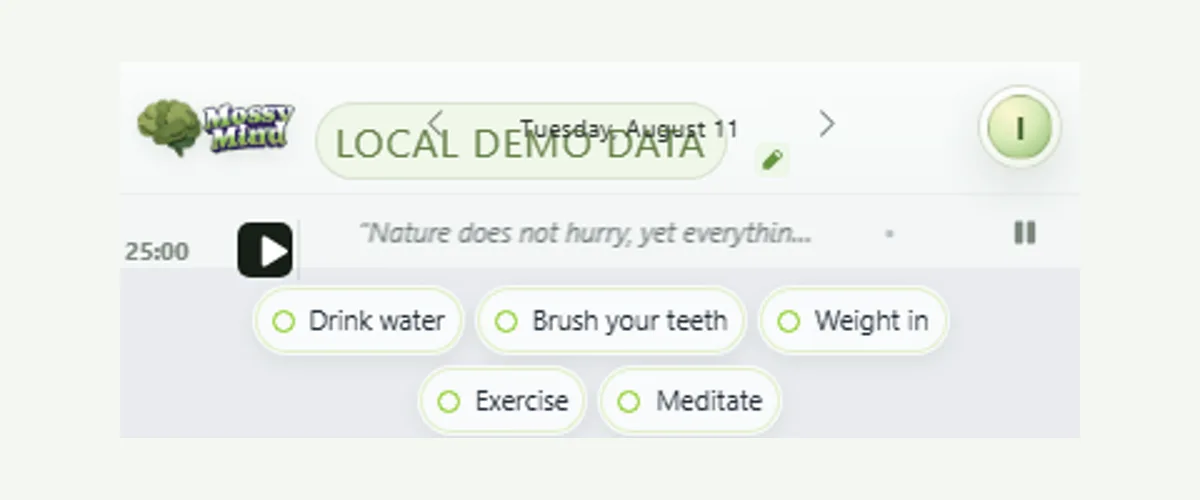 See how it works
Research behind this page
Primary texts are public-domain translations. Research notes explain the ideas discussed here; they do not prove that MossyMind changes how you feel.
- Marcus Aurelius — Meditations, trans. George Long (Project Gutenberg #15877)
Public-domain translation, published as Thoughts of the Emperor Marcus Aurelius Antoninus. Its book and section numbers are used for every Meditations quote on this site.
- Epictetus — The Enchiridion, trans. Thomas Wentworth Higginson (Project Gutenberg #45109)
Public-domain translation. Chapter 1 divides things into those within our power and those beyond it; chapter 5 locates distress in our views of things.
- Stanford Encyclopedia of Philosophy — Stoicism
Founding by Zeno around 300 BCE, preferred indifferents, and why the Stoic ideal includes “good feelings” rather than no feeling.
- Internet Encyclopedia of Philosophy — Marcus Aurelius
The Meditations as a personal notebook written in Greek on campaign, not meant for publication, with a recurring cosmic perspective.
- Cavanna et al. (2023) — The Western origins of mindfulness therapy in ancient Rome
Neurological Sciences review documenting that Albert Ellis credited Epictetus and that Aaron Beck traced cognitive therapy’s philosophical roots to the Stoics.
- Boostani et al. (2025) — Stoic philosophy teachings in nursing and allied health: a scoping review
Of 28 included studies, about 43 percent were theoretical and about 7 percent interventional; the authors call for more intervention research.
- Harerimana et al. (2025) — The pitfalls of “toughing it out”: stoic attitudes in cancer patients
Scoping review of 12 studies separating Stoicism the philosophy from lower-case stoic attitudes, which were linked to suppression and delayed help-seeking.