What is on the page
Check energy before choosing tasks
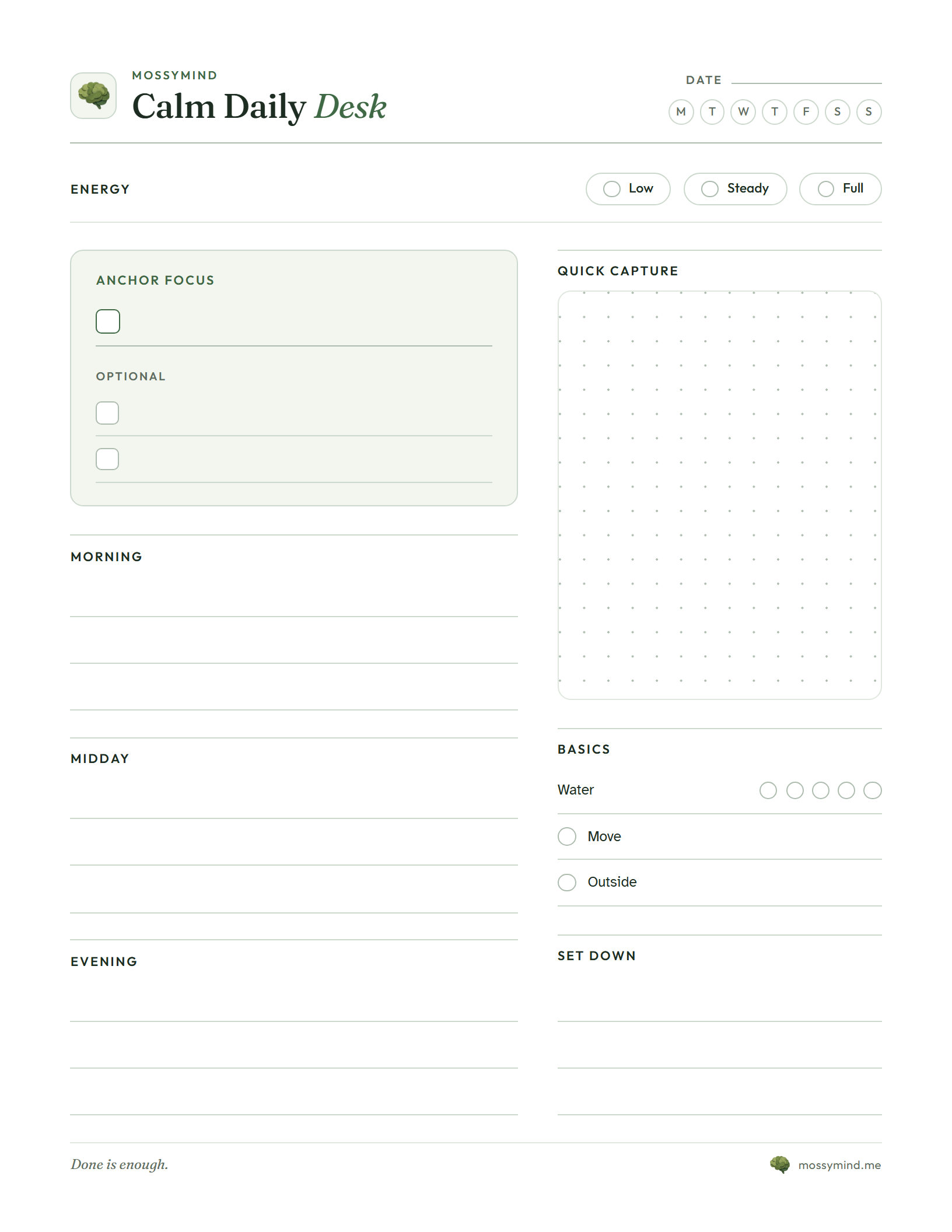
Starts with an Energy check (Low · Steady · Full) before choosing commitments.
Loose windows, not half-hour slots
Uses Morning, Midday, and Evening windows that survive schedule changes.
Undated: write in any day
Undated layout—skip any weekday or weekend without wasting bound pages.
Hourly time-blocked planners look crisp at 8:30 a.m. and feel broken by 10:15 a.m. the moment a call runs long. This free undated one-page daily planner printable replaces brittle half-hour slots with an honest Energy check (Low, Steady, or Full), one Anchor Focus plus two optional tasks, flexible Morning / Midday / Evening windows, a Quick Capture dot pad for mid-day thoughts, gentle Basics (water, movement, outside), and a Set Down line to end the day cleanly.
Jules’s Wednesday
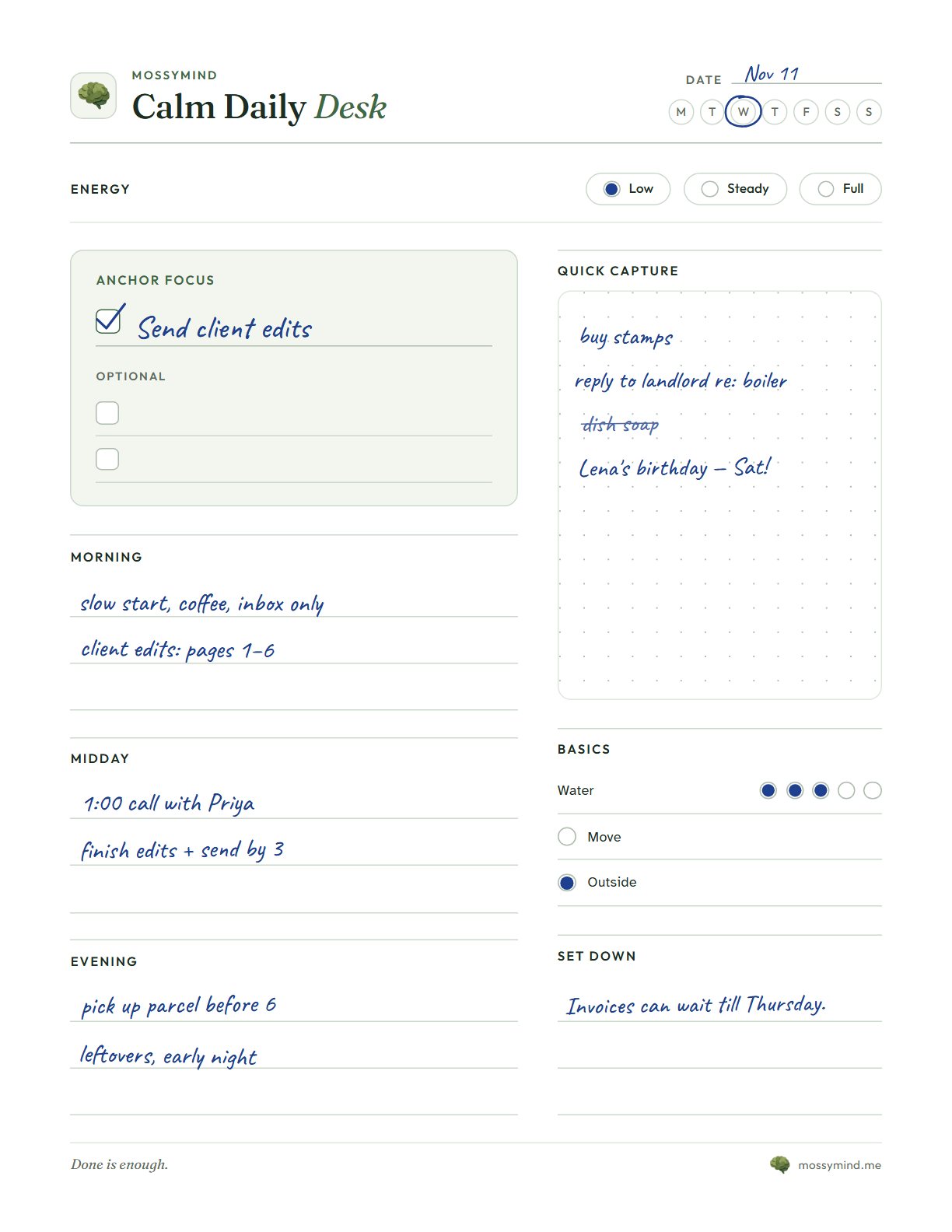
A disrupted morning stays intact without redrawing arrows
- Before
- Jules wakes up after five hours of sleep, checks Low energy, and still needs to ship client edits and pick up prescriptions.
- On the sheet
- Jules puts “Send client edits” in Anchor Focus, leaves the two Optional checkboxes empty, places prescriptions in Evening, and uses Quick Capture when random errands pop up. Both essentials finish without hourly-grid guilt.
Why soft time windows outlast rigid half-hour blocks
Time-perception differences and real-world interruptions make 30-minute schedules fragile. As our guides on ADHD daily planning and flexible time blocking explain, grouping a day into Morning, Midday, and Evening preserves sequence and context while leaving breathing room when life shifts.
Checking Low, Steady, or Full at the top of the sheet calibrates expectations before your optimism writes checks your afternoon energy cannot cash. If getting out the door is the hardest window, pair it with the ADHD morning routine checklist.
Connecting Quick Capture and Set Down at the end of the day
Keep the sheet beside your keyboard so new requests land in the right-hand Quick Capture dot box instead of hijacking your Anchor Focus. Gentle water, movement, and outside cues sit quietly below without turning hydration into a performance.
Before closing your laptop, write one sentence in Set Down naming what can wait until tomorrow, or flip the page over to the daily journal template. For bigger weeks, pair this sheet with the ADHD weekly planner printable or daily to-do list printable.
Plan your day in four simple steps
- Mark today’s date, circle the weekday, and check Low, Steady, or Full energy.
- Write one Anchor Focus—and leave Optional blank if energy is Low.
- Place fixed appointments and loose blocks into Morning, Midday, or Evening.
- Catch stray thoughts in Quick Capture and close the day with one Set Down line.
Questions people ask
Why are there no hourly timestamps like 9:00, 9:30, and 10:00?
Rigid timestamps turn one 20-minute delay into a cascade of crossed-out boxes. Inside Morning, Midday, and Evening, you can still jot a hard meeting time (“11:00 dentist”) while keeping the rest of the window flexible.
Can I print this daily planner double-sided?
Yes. Many readers print this Undated Daily Planner on the front and either the Brain Dump Printable Template or Daily Journal Template on the back for a single-sheet daily clipboard.
How does this compare to a paper notebook vs. a planning app?
A single printed sheet gives tactile focus for today without notifications, while an app remembers next Thursday and carries unfinished items forward. Many people use both—paper on messy mornings, MossyMind as home base.
Research behind this page
This research explains the challenges discussed here. It does not prove that MossyMind changes ADHD symptoms or any health outcome.
- CDC — ADHD in Adults
Current overview of adult ADHD and common difficulties with attention, lengthy tasks, and organization.
- Metcalfe et al. — ADHD time-perception meta-analysis
Systematic review and meta-analysis of time-perception differences across the lifespan.
- NICE guideline NG87 — ADHD diagnosis and management
Clinical guidance that includes individualized environmental modifications and non-pharmacological support.