
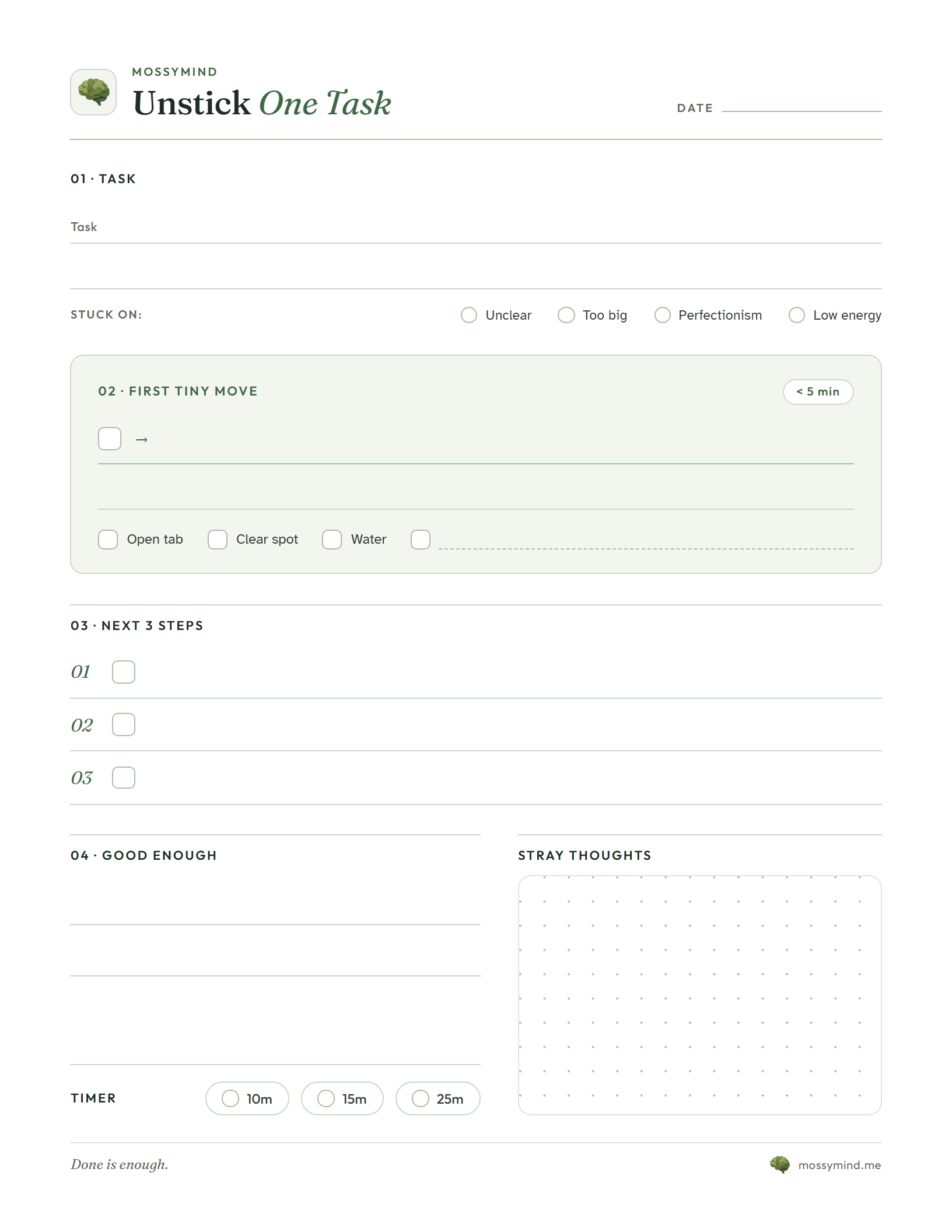
What is on the page
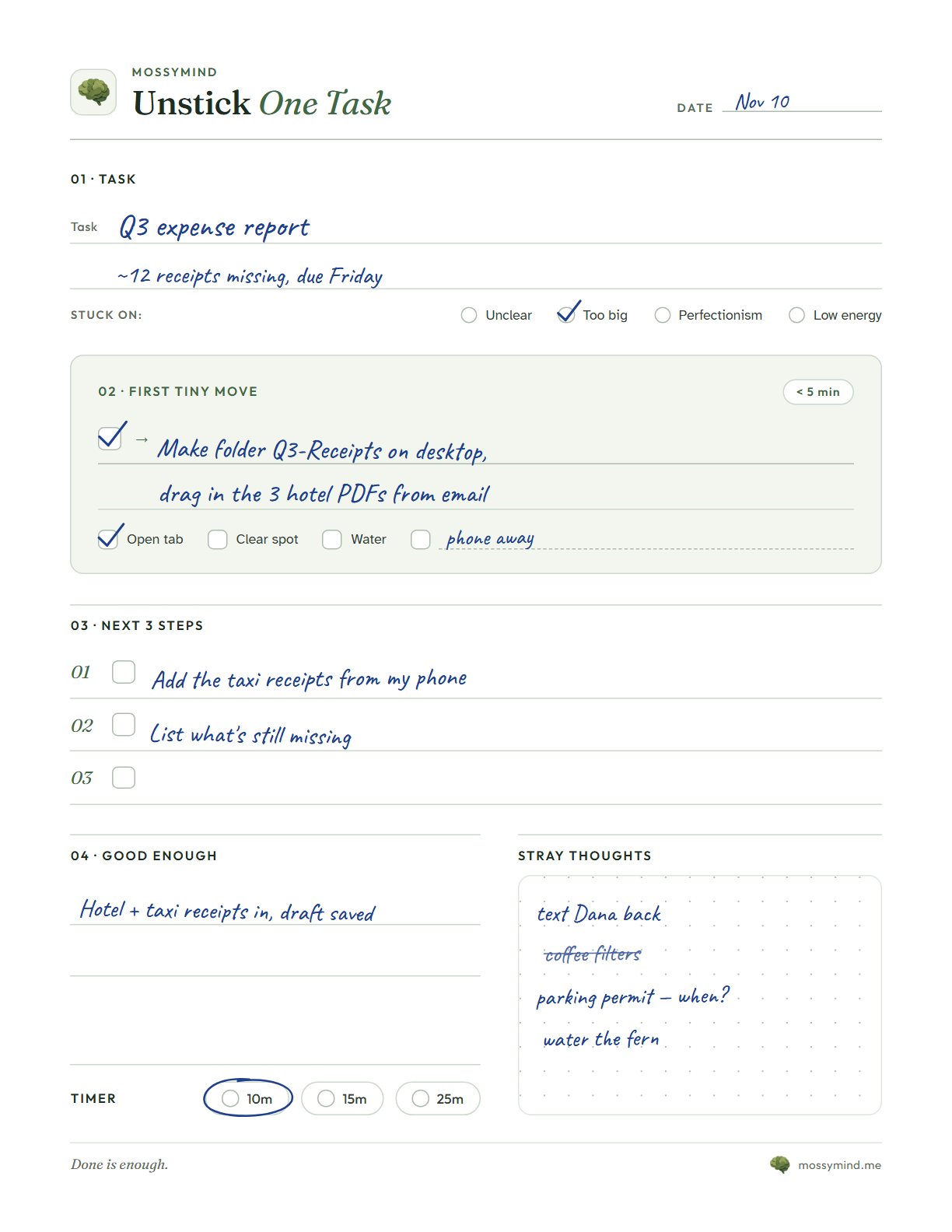
One avoided task, named
Isolates a single avoided project so nothing else on the page competes.
A first move under five minutes
Turns vague resistance into a concrete under-five-minute physical entrance.
Stray thoughts wait on the pad
Includes a Stray Thoughts dot pad and 10m / 15m / 25m timer check-in.
When you know what to do and care about the outcome yet still cannot start, writing the project title on a fifth to-do list will not move it. Usually “File taxes” or “Reply to client” is hiding six unmade decisions and an invisible finish line. This free one-page executive function task breakdown worksheet isolates one avoided task, names the friction (Unclear, Too big, Perfectionism, or Low energy), scripts a physical move under five minutes, and sets a Good Enough stopping point.
Marcus’s expense report
Breaking three days of avoidance on an expense report
- Before
- Marcus has avoided “Q3 expenses” for four days because opening the portal makes him think of twelve missing receipts at once.
- On the sheet
- He checks Too big, writes “Create folder Q3-Receipts on desktop and drag in the three hotel PDFs from email” in 02 · First Tiny Move, circles 10m at the bottom, and finishes the entrance before the ten minutes end.
Why task initiation breaks before the first verb
Avoidance rarely means laziness; it usually means the entrance cost is unspoken. Our ADHD task paralysis guide and breaking goals into steps guide show how naming the very first object, tab, or file cuts the startup tax in half.
Checking one of the four Stuck On pills (Unclear, Too big, Perfectionism, Low energy) tells you what kind of first move to write: clarify one question, slice off a tiny corner, write an intentionally rough draft, or work from the couch for ten minutes.
Using Good Enough and the Stray Thoughts pad
Perfectionism stalls tasks at both ends: starting feels heavy because finishing has no edge. Writing a plain-English finish condition in 04 · Good Enough (“Draft sent for feedback, typos allowed”) protects you from moving the goalposts mid-session.
While your 10-, 15-, or 25-minute timer runs, jot sudden urges to check messages onto the Stray Thoughts dot pad instead of switching tabs. Afterward, return to the daily to-do list printable or log what worked on the daily journal template.
Break down one overwhelming task in five minutes
- Write the one task you have been avoiding on line 01 · Task.
- Tick what is making it heavy: Unclear, Too big, Perfectionism, or Low energy.
- Check Open tab, Clear spot, or Water, and write one move under 5 minutes.
- List only the next three visible steps—leave step twelve for later.
- Define Good Enough, circle 10m, 15m, or 25m, and do only the first move.
Questions people ask
What counts as a small enough First Tiny Move?
A move you could film someone doing in under two to five minutes without making a new decision: open the document and type three bullet headings, put the return box by the front door, or look up one phone number.
Should I fill out Next 3 Steps before doing the first move?
Only if they are already obvious. If thinking about steps two and three makes you stall again, leave section 03 blank, run a 10-minute timer on your First Tiny Move, and write step two after you have momentum.
Is this executive function worksheet meant for adults or students?
It is written in clean, practical language for adults, remote workers, freelancers, and college students navigating multi-step projects, admin tasks, or household paperwork.
Research behind this page
This research explains the challenges discussed here. It does not prove that MossyMind changes ADHD symptoms or any health outcome.
- CDC — ADHD in Adults
Current overview of adult ADHD and common difficulties with attention, lengthy tasks, and organization.
- NICE guideline NG87 — ADHD diagnosis and management
Clinical guidance that includes individualized environmental modifications and non-pharmacological support.
- Alderson et al. — Adult ADHD and working memory meta-analysis
Meta-analysis of 38 studies comparing working-memory performance in adults with and without ADHD.