
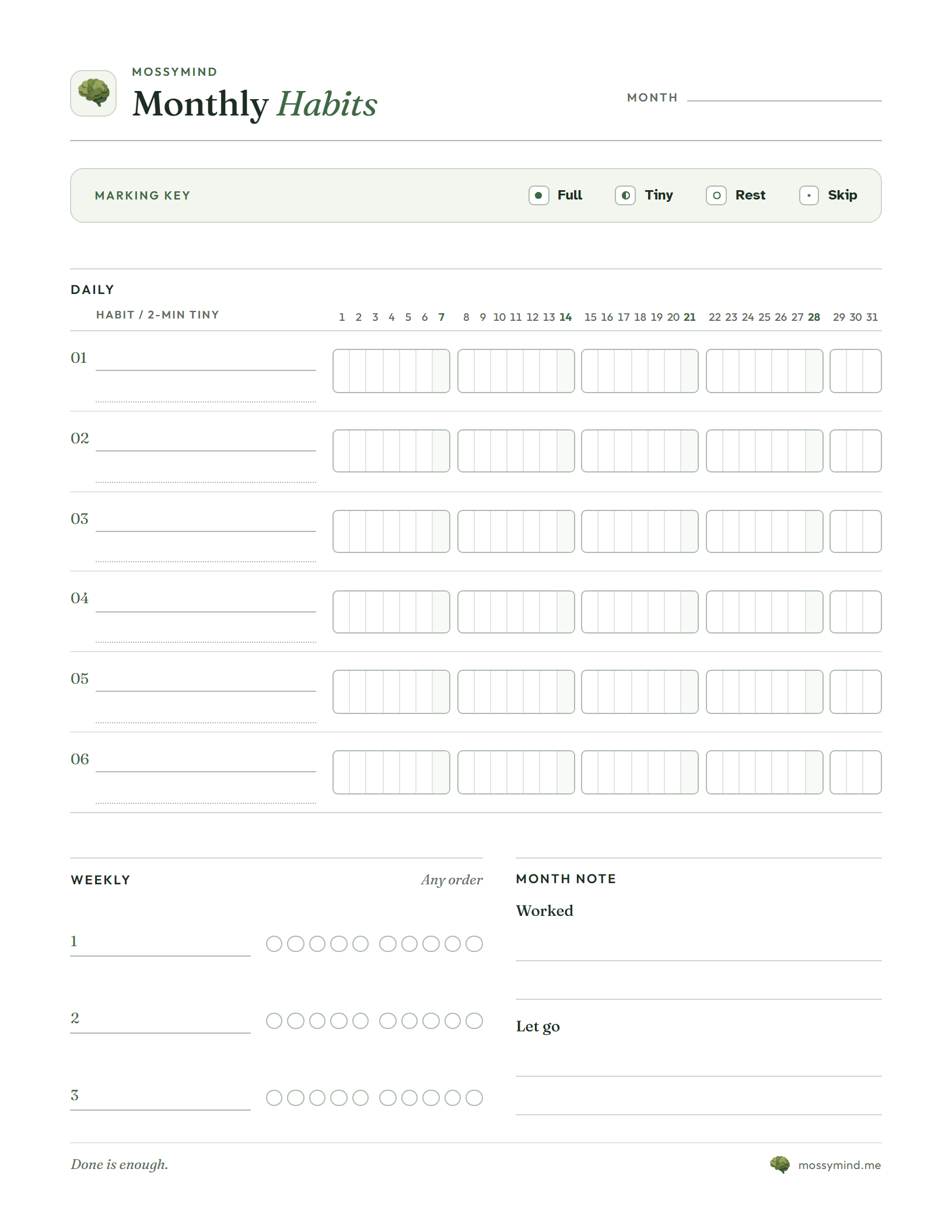
What is on the page
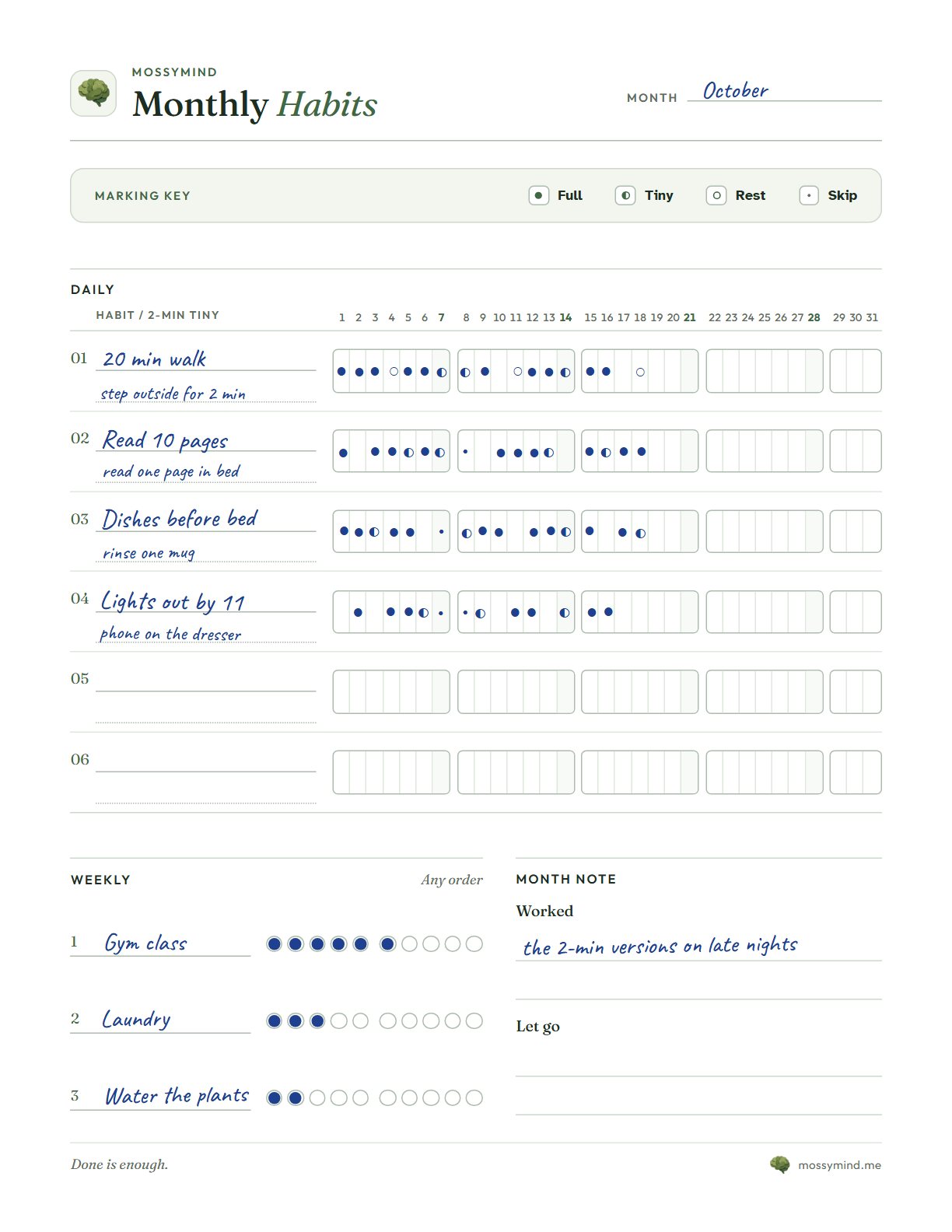
Each habit has a 2-minute version
Pairs every daily habit with a pre-written 2-minute version for busy or tired days.
Full, Tiny, Rest and Skip marks
Four-state key (Full · Tiny · Rest · Skip) replaces fragile all-or-nothing streaks.
Gym and laundry live under Weekly
Includes a separate Weekly habits section for non-daily routines like gym or laundry.
Traditional 31-day habit tracker printables treat a two-minute stretch, a flu day, and giving up as the exact same empty white square—and cram fifteen aspirational habits onto one page. This free monthly habit tracker printable limits daily habits to six readable rows, gives every habit a 2-minute tiny backup line underneath, uses a four-state marking key (Full, Tiny, Rest, Skip), and moves 2–3×/week routines into a separate Weekly section so they never look missed.
Nadia’s October
Keeping a reading and movement rhythm alive through a busy month
- Before
- Nadia usually quits monthly habit trackers by the 9th after two late work nights leave blank gaps across every row.
- On the sheet
- She writes “20 min walk / tiny: step outside for 2 min” on row 01. On late nights she marks a half-filled dot for Tiny and an open circle for Rest on Sunday. At day 31 she sees twenty-six engaged days instead of a “broken” streak.
Why broken streak counters make people quit good habits
Research on habit formation shows that missing a single opportunity does not erase the cue-behavior link—yet behavioral studies show that staring at a broken streak lowers motivation afterward anyway. Read the research and restart script in what to do when you break a habit streak and building habits with ADHD.
Giving Tiny (a half-dot) and Planned Rest (an open circle) their own symbols turns the monthly grid into an honest record rather than a pass/fail scorecard.
Keeping weekly habits out of the 31-day daily grid
Putting a three-times-a-week workout onto a 31-day grid guarantees four blank squares every week, training your eyes to ignore empty boxes. Use the bottom-left Weekly section for anything done a few times a week, and close the month with two short lines: Worked and Let go.
For morning-specific routines, pair this monthly tracker with the ADHD morning routine checklist, or put monthly bills and household chores on the adult chore chart and recurring schedule.
Set up your monthly habit tracker in five minutes
- Write the month at the top and choose only 3 to 6 daily habits (leave extra rows blank).
- On the second line inside each habit box, write its 2-minute tiny version.
- Put 2–4× per week routines in the bottom-left Weekly circles instead of the daily grid.
- Mark ● for Full, · for Tiny, ○ for Rest, or — for Skip as days happen.
- At month’s end, jot one thing that Worked and one habit to Let go.
Questions people ask
How many habits should I track at once on this printable?
Start with three—even though six rows are provided. Leaving rows 04 through 06 empty makes the three habits you actually care about much easier to spot and keep on tired evenings.
Why are the 31 day columns grouped into blocks of seven?
Thirty-one identical narrow columns make your pen slip onto the wrong row halfway across the month. Visual gaps every seven days let your eyes track straight across from the habit name without a ruler.
What is the difference between Rest and Skip in the marking key?
Rest (○) marks intentional recovery, travel, or illness where not doing the habit was the right call. Skip (a small dot) acknowledges “life happened” so you never stare at an unexplained blank gap.
Research behind this page
This research explains the challenges discussed here. It does not prove that MossyMind changes ADHD symptoms or any health outcome.
- Lally et al. (2010) — How are habits formed: Modelling habit formation in the real world
96 volunteers repeated a chosen daily behavior for 12 weeks; time to reach most of its automaticity ranged from 18 to 254 days.
- CDC — ADHD in Adults
Current overview of adult ADHD and common difficulties with attention, lengthy tasks, and organization.